
When an Elimination Diet Has to Do Two Jobs at Once
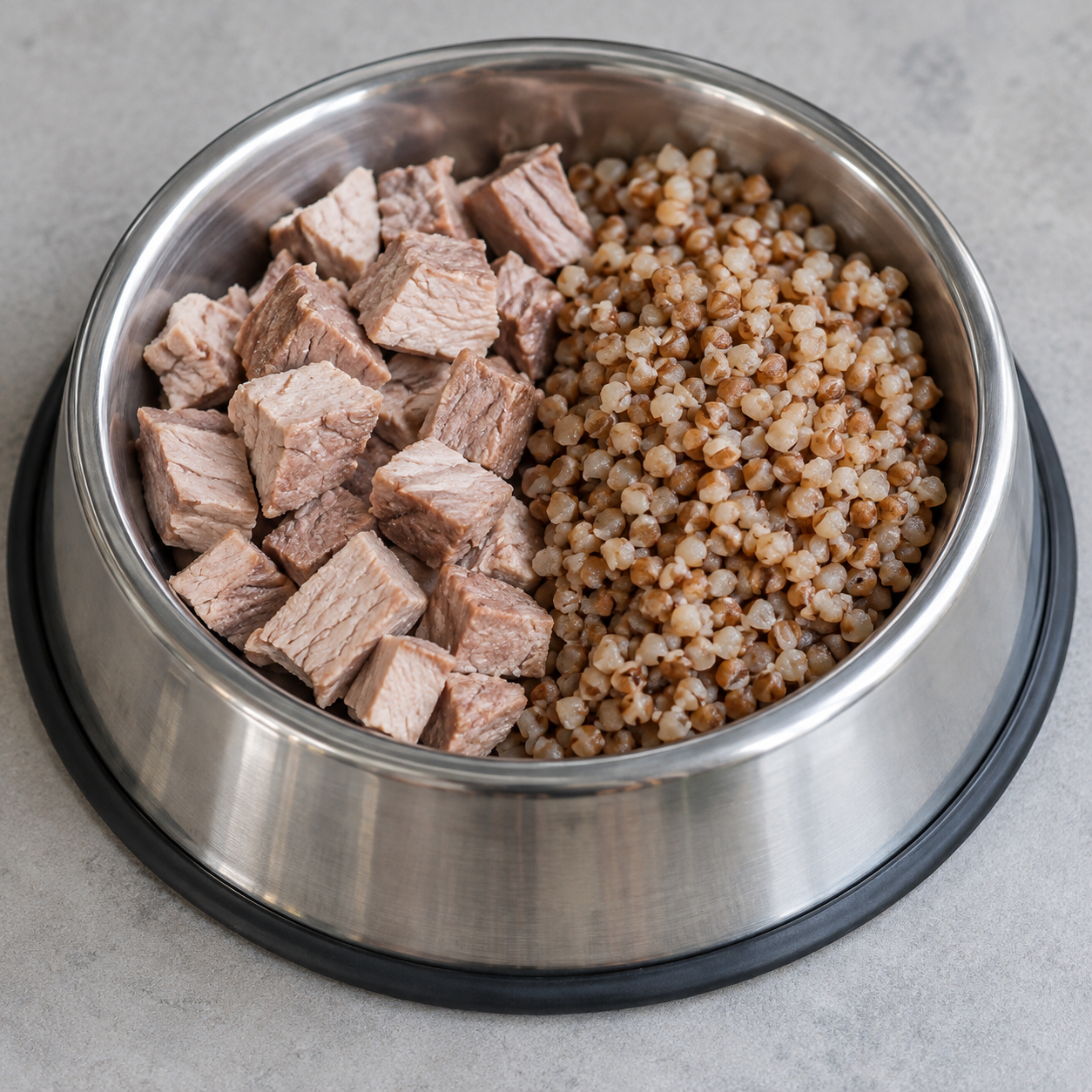
Elimination diets sound simple on paper: choose foods the dog has never eaten before, feed them exclusively for a period of time, and see what happens. In practice, some cases require much tighter control.
I’m currently working with a senior dog who has a long history of chronic issues. Symptoms include recurring ear inflammation and yeast infections, intermittent itching, and gastrointestinal sensitivity. Food has not been established as the cause. Environmental allergy is still very much part of the differential. The purpose of the elimination diet is to answer one specific question as cleanly as possible:
Is food contributing meaningfully to this dog’s chronic ear and skin problems?
There is one additional complication: the dog also has a documented history of pancreatitis.
That means I can’t simply choose a novel protein and carbohydrate and call it an elimination diet. I also have to control the amount of fat very carefully.
Step One: Find Out What the Dog Has Actually Eaten
One of the most important parts of an elimination diet happens before the first step is even taken: I reconstruct the dog’s food exposure history.
In this case, several years of commercial diets had already exposed the dog to a broad range of ingredients.
The veterinary record turned up additional exposures that were easy to miss. During a previous digestive episode, for example, the dog had eaten ground turkey as part of a temporary home-prepared diet. That makes turkey unsuitable as a truly novel protein even though it was not part of the regular kibble history.
This is why I do not rely solely on the ingredient list of the dog’s current food. Treats, temporary bland diets, chews, supplements, table foods and flavored medications all count.
Supplements Count as Food Exposure Too
This is another area where elimination diets frequently become contaminated without anyone realizing it.
Joint supplements, urinary supplements, probiotics and other chewable products often contain ingredients such as liver flavor, chicken cartilage, brewer’s yeast, fish oil, gelatin or other animal-derived flavorings.
For a normal dog, that may be completely unremarkable. For a strict two-ingredient elimination diet, it matters.
So during the initial Elimination phase, the dog’s flavored and food-derived supplements are being discontinued. They can be addressed later, one at a time, during the reintroduction phase. When a supplement serves an important purpose, I look for a simpler alternative that does not introduce another protein source or mystery flavoring.
The goal is not to remove useful supplements forever, just to keep the diagnostic phase clean enough that the results actually mean something.
The Elimination Phase Is Truly Two Ingredients
For a true Elimination Diet, the starting point is not “limited ingredient” or a hydrolyzed protein commercial food. It is two ingredients: one protein source + one carbohydrate source.
No treats, no snacks, no flavored chews. No rotating proteins. No handful of “safe” extras because they seem harmless.
Every additional ingredient creates another variable.
For the carbohydrate, buckwheat is being used because it does not appear in the dog’s known food history. Several obvious alternatives were already ruled out by previous exposure. The veterinary record even contained an older reference to a chicken-and-sweet-potato food that was not obvious from the more recent diet history.
For the protein, the same rule applies: it needs to be genuinely novel based on the best exposure history we can reconstruct.
Why I Am Not Using a Commercial Prescription Diet
Veterinary novel protein and hydrolyzed protein diets can sometimes be useful tools in food trials, and they are generally manufactured with tighter controls against cross-contamination than ordinary commercial “limited ingredient” foods.
But they are not a tool I use in my approach. A hydrolyzed diet is still a multi-ingredient commercial formula. In addition to its primary protein and carbohydrate sources, it typically contains fats, fibers, vitamin and mineral supplements, amino acids, oils, and other formulation ingredients – many of the same supplemental ingredients routinely found in “over the counter” commercial foods. Hydrolysis may greatly reduce the likelihood that a protein will trigger a reaction, but it does not make the entire formula a true two-ingredient diet.
More importantly, if dogs improve while eating a commercial therapeutic formula, what I would learn is that they do better on that formula. I have not yet learned which individual ingredients are truly well tolerated.
Starting with one known protein and one known carbohydrate gives me much tighter control over what enters the dog, and it makes the later challenge phase far easier to interpret. Ingredients can then be added back individually, including necessary supplements, so that a reaction can be tied much more cleanly to a specific exposure rather than to an entire commercial formulation.
Why Pancreatitis Changes the Plan
The dog’s pancreatitis history means I also need to know approximately how much fat they have been consuming.
The current prescription low-fat diet provides roughly 14 grams of fat per day from the food product itself at the amount she has been eating. The earlier commercial diet was considerably higher in fat, and when the previous salmon oil supplement is included, historical intake was substantially higher still.
That history is useful.
It tells me that I do not necessarily need to keep this dog at an extremely low fat intake forever. But it also does not justify suddenly jumping from a prescription low-fat diet to a much richer home-prepared diet.
After pancreatitis, tolerance and careful reintroduction is important.
So I am using the current prescription diet as the starting reference point and increasing fat conservatively rather than making a large change overnight.
Starting Lower Than We May Ultimately Need
The first version of the elimination recipe uses carefully defatted meat.
At the amounts currently being considered, that puts the diet at roughly 10.5 grams of fat per day.
That is deliberately conservative – it gives us room to transition gradually away from the prescription diet without simultaneously increasing dietary fat.
Once the dog is fully transitioned and doing well, the meat does not necessarily have to remain aggressively defatted forever.
A later version using lean, non-defatted meat would provide about 19 grams of fat per day.
That is somewhat higher than the prescription diet, but still dramatically lower than the dog’s previous intake before pancreatitis.
The important part is the progression.
I would much rather move upward gradually as tolerated than jump immediately to the final target simply because the dog historically ate more fat.
Why Not Keep It Extremely Low Forever?
Because “lower” is not automatically “better.”
The goal is not to remove as much fat as physically possible. Fat is an important nutrient and calorie source, and overly aggressive restriction can make home-prepared diets unnecessarily difficult to balance and feed.
The goal is to find a level that is well tolerated by this individual dog.
In this case, I already know three useful things:
The dog
* historically tolerated a much higher-fat diet before the pancreatitis episode and
* is currently stable on a prescription low-fat diet.
And I can formulate the initial elimination diet below that current fat intake while we transition.
That gives us a controlled starting point rather than guessing.
One Change at a Time
This case is an excellent example of why I dislike making multiple dietary changes at once.
If I changed the protein, carbohydrate, fat level, supplements and several other variables simultaneously and the dog developed diarrhea, I would have no idea which change caused it.
Likewise, if the ear issues improved, I wouldn’t know whether the improvement resulted from removal of a particular dietary protein, withdrawal of a flavored supplement, a medication change, normal seasonal fluctuation, or something else.
So the plan is deliberately boring:
* Two ingredients, controlled calorie intake, a conservative fat level, and a gradual transition.
* Careful monitoring of stool quality, appetite, digestive signs, itching, ear debris, head shaking and other clinical changes.
* Then, once we have established a stable baseline, foods and necessary supplements can be reintroduced systematically.
An Elimination Diet Is a Diagnostic Process
The point of an elimination diet is not simply to feed a “cleaner” diet.
It is to gather useful information.
If symptoms improve during strict elimination and then return when a particular ingredient is challenged, that tells us far more than continually switching among commercial “sensitive skin” or “limited ingredient” foods.
And if nothing meaningful changes despite a carefully controlled trial, that is useful information too.
In this dog’s case, the diet has an additional job: it must answer the food question without unnecessarily increasing the risk of a gastrointestinal or pancreatic episode.
That is why the plan may look almost excessively controlled at first.
It’s controlled on purpose.
The fewer variables we introduce during the diagnostic phase, the more confidently we can interpret what happens next.