
Calcium During Pregnancy: What “Don’t Supplement” Really Means
Calcium needed to balance a pregnant dog’s diet is part of her basic nutrition. Extra supplementation provides calcium on top of a diet that already meets her needs. Calling both “supplementing” blurs this important distinction.[1,2]
Calcium supports the puppies’ developing skeletons and the mother’s nerve and muscle function, including uterine contractions during whelping. Low blood calcium around delivery can contribute to weak contractions and difficult labor, or dystocia. Adequate calcium matters throughout pregnancy, during whelping, and as milk production begins.[1–3,24]
The advice to avoid calcium supplements assumes the diet already supplies enough. A dog eating an appropriate complete commercial food generally needs no extra calcium. A homemade diet, whether cooked, raw, or a combination, may require a measured supplement to meet her needs.[1,18]
Why is extra calcium during pregnancy discouraged?
Before whelping begins, extra calcium should not be routinely added to an already adequate diet to prepare for labor or prevent eclampsia. Eclampsia is a dangerous drop in blood calcium that usually occurs during lactation; giving extra calcium during pregnancy can increase that risk.[2]
Parathyroid hormone (PTH) helps maintain blood calcium by promoting calcium release from bone, conservation by the kidneys, and vitamin D activation to support intestinal absorption. When blood calcium rises, PTH secretion falls.[3] Excessive calcium intake during pregnancy can suppress PTH production and downregulate the body’s calcium-regulating system.[2,25]
The concern is that calcium mobilization may then fail to keep pace around whelping and as milk production sharply increases demand. If blood calcium falls during labor, the uterine muscles may not contract effectively, contributing to weak contractions and difficult delivery. This is how giving too much calcium beforehand can work against the very muscle function it was intended to support.[2,3,24]
This is a possible contributing mechanism, not the explanation for every case of weak contractions or eclampsia. The glands do not simply “shut off”: Merck notes that inadequate PTH production during the hypocalcemic crisis does not explain canine eclampsia. Inadequate dietary calcium and heavy milk production also contribute to risk.[2]
Withholding a necessary calcium source is therefore no solution. Nor can normal blood calcium confirm that a diet supplies enough: calcium released from bone can maintain blood levels for quite some time despite a dietary shortfall.[1,3]
Once whelping is underway, or during lactation, additional calcium may be appropriate under veterinary guidance. That use, and treatment of diagnosed hypocalcemia, differs from routine supplementation before labor. Whelping itself does not mean every dog needs extra calcium.[2,24]
The myth about “limestone” calcium
There’s a persistent myth in the dog breeding community that calcium from “limestone” is somehow “bad” and “shuts down PTH,” while calcium from food does not. This confuses the effects of excessive calcium intake with the source of the calcium.
Limestone is predominantly made up of calcium carbonate, as are eggshells and oyster shells.[4,6] Calling one “food calcium” and another “calcium from rocks” obscures their shared chemistry. The parathyroid glands respond to ionized calcium in the blood, regardless of its dietary source.[3]
Calcium carbonate used in supplement products (human and animal!) commonly starts with mined limestone. Selected deposits may be finely ground, or processed into lime and reacted with water and carbon dioxide to form precipitated calcium carbonate. Both forms are available for food and supplement use.[21,22]
Food-grade quality matters. Choose a product intended for dietary use, with declared elemental calcium content and documented purity standards, including limits on contaminants such as lead. Agricultural or industrial limestone powder is not an interchangeable substitute. Mined origin does not make a supplement unsuitable; the finished product’s purity and the amount used matter.[22,23]
A feed manufacturer may add calcium carbonate to complete a commercial formula, just as you might measure it into a homemade recipe. Its presence does not mean the diet contains excess calcium. Conversely, “natural” sources such as bone and eggshell can supply too much when added to an already adequate diet.
Start with the diet she already eats
For kibble, check the nutritional adequacy statement. The Association of American Feed Control Officials (AAFCO) publishes two dog food nutrient profiles used for U.S. pet food adequacy claims: Adult Maintenance and Growth and Reproduction. Growth and Reproduction covers pregnancy and lactation. “All life stages” includes reproduction; it is not a third profile.[16,17]
The same label check applies to all other commercial food options. Some are complete diets; others, including some raw grinds and toppers, are intended for intermittent or supplemental feeding.[17,19] A complete food suitable for reproduction already supplies sufficient calcium, phosphorus, magnesium, vitamin D, and other essential nutrients when fed in an appropriate amount.[16,18]
For homemade diets, the recipe must provide these nutrients through ingredients and, as necessary, added supplements. Boneless meat supplies substantial phosphorus but little calcium, so a calculated calcium source is usually needed. Use a recipe formulated for pregnancy; an adult-maintenance recipe may fall short even if it contains calcium.[1]
When combining commercial and homemade food, account for both portions. Kibble does not automatically balance whatever is added to it. Replacing substantial amounts of kibble with boneless meat changes the calcium supplied relative to phosphorus and calories. The homemade portion can be balanced for reproduction in its own right, or the combination can be formulated as one diet.
How much calcium does a pregnant dog need?
The National Research Council (NRC) evaluates nutrient needs in Nutrient Requirements of Dogs and Cats. It discusses a recommended allowance of 160 mg calcium per kilogram (2.2 lb) of body weight daily during the last three weeks of pregnancy, assuming 40% bioavailability. Its example of a 22 kg (48.5 lb) dog eating approximately 2,200 kcal daily translates to 1.6 g calcium per 1,000 kcal of metabolizable energy (ME).[1, p. 150]
Here is how the mineral values compare:
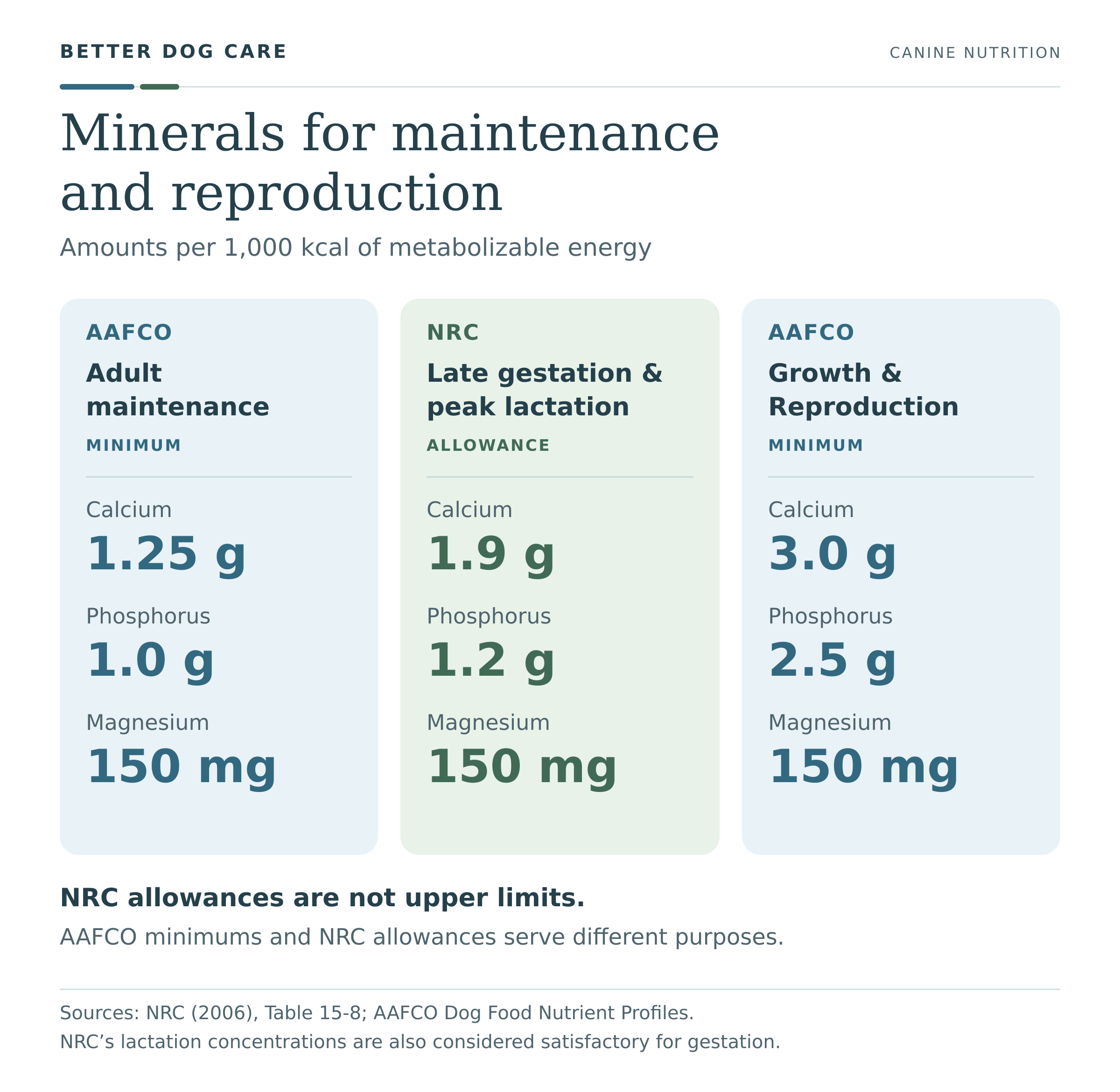
NRC’s summary table for late gestation and peak lactation lists 1.9 g calcium per 1,000 kcal. Its footnote explains that the dietary concentrations for lactation may also be considered satisfactory for gestation.[1, Table 15-8, pp. 362–363]
AAFCO’s maintenance calcium minimum falls below both NRC gestation figures; its phosphorus minimum is also lower than NRC’s allowance. An individual maintenance food may contain more, but its full nutrient analysis is needed to assess whether it meets pregnancy needs. Magnesium has the same value in all three columns, illustrating why each nutrient needs its own assessment. Adding calcium alone to fill a nutritional gap cannot establish that the diet meets the other needs of pregnancy.[1,20]
NRC allowances are not upper limits. Research establishing minimum requirements during gestation is limited. AAFCO minimums and NRC allowances serve different purposes; the higher AAFCO growth/reproduction calcium value does not itself indicate excess. The calcium figures describe elemental calcium in the entire diet, including supplements. They are neither the weight of calcium carbonate powder nor an amount to add on top of what the diet supplies.[1,20]
Calcium works with phosphorus, magnesium, and vitamin D
The calcium-to-phosphorus ratio compares the minerals by weight. NRC’s allowances of 1.9 g calcium and 1.2 g phosphorus per 1,000 kcal work out to approximately 1.6 to 1. This is a calculated ratio, not a separate requirement to match that number exactly. The same ratio can occur with too little, enough, or too much of both minerals, so their actual amounts matter.[1]
Magnesium supports enzyme activity, nerve and muscle function, and calcium regulation. Severe depletion can reduce PTH release and contribute to low blood calcium. Excessive calcium can reduce phosphorus absorption; excessive calcium or phosphorus can also interfere with magnesium absorption by forming poorly soluble complexes in the intestine.[1,7,8] NRC’s magnesium allowance is 150 mg per 1,000 kcal for late gestation and peak lactation. Its table supplies individual allowances, not a universal calcium–phosphorus–magnesium ratio. Calculate magnesium separately, including contributions from food, bone, and supplements.[1]
Vitamin D is activated through the liver and kidneys. Its active form, calcitriol, increases intestinal absorption of calcium and phosphorus and supports normal bone development. Too little vitamin D can impair calcium utilization even when enough calcium is present; too much can raise blood calcium and phosphorus and damage the kidneys and other tissues.[3,7] These relationships apply to every calcium source. Count vitamin D included in supplements along with what the food provides.
For detailed commercial-food calculations, request typical mineral values and calorie content from the manufacturer. Minimum guarantees are not exact amounts. Comparing nutrients per 1,000 kcal is particularly useful when combining kibble with foods containing much more moisture.[1,16]
Choosing a calcium source
Edible bone and bone meal supply phosphorus along with calcium. Finely ground eggshell, calcium carbonate, and calcium citrate supply little or no phosphorus, which can be useful when meat already provides plenty. Replacing bone with one of these changes phosphorus and potentially magnesium, even if the calcium amount stays the same.[1,6]
Carbonate depends more on an acidic environment for dissolution than citrate. Human research supports taking carbonate with food and suggests citrate can help when stomach acid is low. This explains a difference between the compounds, but does not establish fixed canine absorption rates or make citrate the best choice for every dog.[5]
Calcium carbonate is one of the most concentrated common options: 40% elemental calcium by weight, compared with approximately 21% for calcium citrate used in supplements. Providing 1,000 mg calcium takes about 2.5 g (0.088 oz) carbonate or 4.8 g (0.169 oz) citrate, before any fillers are included.[5] Carbonate can therefore mean less powder or fewer tablets. Actual volume and tablet count depend on the product’s declared elemental calcium and serving size.
Seaweed calcium: Aquamin and Sea-Cal
Aquamin® is Marigot’s trademarked range of marine minerals. Its seaweed calcium products come from calcified red algae, Lithothamnion species. Aquamin F contains calcium mainly as calcium carbonate, together with magnesium and trace minerals. The manufacturer’s brochure lists approximately 32% calcium and 2.2% magnesium; other Aquamin grades have different compositions.[26,28]
Animal Essentials Sea-Cal is a retail example of this type of calcified red-algae calcium. Its current label declares 33–38% calcium, at least 3% magnesium, and at least 0.5% phosphorus. Per 3 g (0.106 oz) teaspoon, that works out to 990–1,140 mg calcium, at least 90 mg magnesium, and at least 15 mg phosphorus. Its iodine minimum of 20 ppm also contributes at least 60 mcg per teaspoon.[27] These are label guarantees, not exact batch values or pregnancy dosing instructions.
This can be a useful calcium source, but its magnesium and other minerals must be counted when replacing plain calcium carbonate, eggshell, or bone meal. Use the finished product’s analysis rather than assuming all seaweed powders or Aquamin grades are interchangeable. Food-grade quality and contaminant testing matter for marine sources too.
Seaweed calcium follows the same normal feedback system as other calcium sources. As absorbed calcium becomes available, PTH release can decrease because less calcium needs to be drawn from bone. A small human trial observed this short-term response after Aquamin F, consistent with normal calcium regulation. This is not evidence of gland damage or a reason to consider Aquamin a poor calcium source.[3,28] The pregnancy concern is sustained excessive intake that can impair adaptation to increasing demand, rather than this normal response to a calcium dose.[2] The human study does not establish superior absorption or pregnancy safety in dogs.[28]
Raw meaty bones
A chicken wing or neck contains meat, skin, and fat as well as bone. Different cuts cannot simply be exchanged gram for gram, and a set bone percentage does not ensure that pregnancy needs are met. Use composition data for the specific cut and the amount actually consumed: research identifies inaccurate meat-to-bone estimates and counting bones offered but not eaten as potential sources of error.[13]
For a prepared raw grind, a calcium and phosphorus analysis provides information that is unavailable if only “with bone” is declared in the ingredient list. Food databases require careful consideration, too: USDA values for many meat and poultry foods describe the edible portion after bone has been removed. Those values cannot describe the entire bone-containing cut.[14]
Include bone, supplements, and any commercial food in the diet’s calcium, phosphorus, and magnesium totals before deciding whether more is needed. Adding a standard calcium dose without counting these sources can create an excess.[1,2]
Bone meal: beef, pork, and product differences
Bone meal supplies calcium mainly as calcium phosphate, including hydroxyapatite, and is useful when both calcium and phosphorus are needed.[9] If phosphorus is already adequate, a calcium source with little or no phosphorus may fit better. Bone meal is not routinely needed on top of complete food suitable for reproduction. Choose a dietary product with declared mineral amounts; gardening products are unsuitable.
Composition depends on processing, retained protein and fat, and added minerals as well as animal source.
Two labels illustrate the differences:
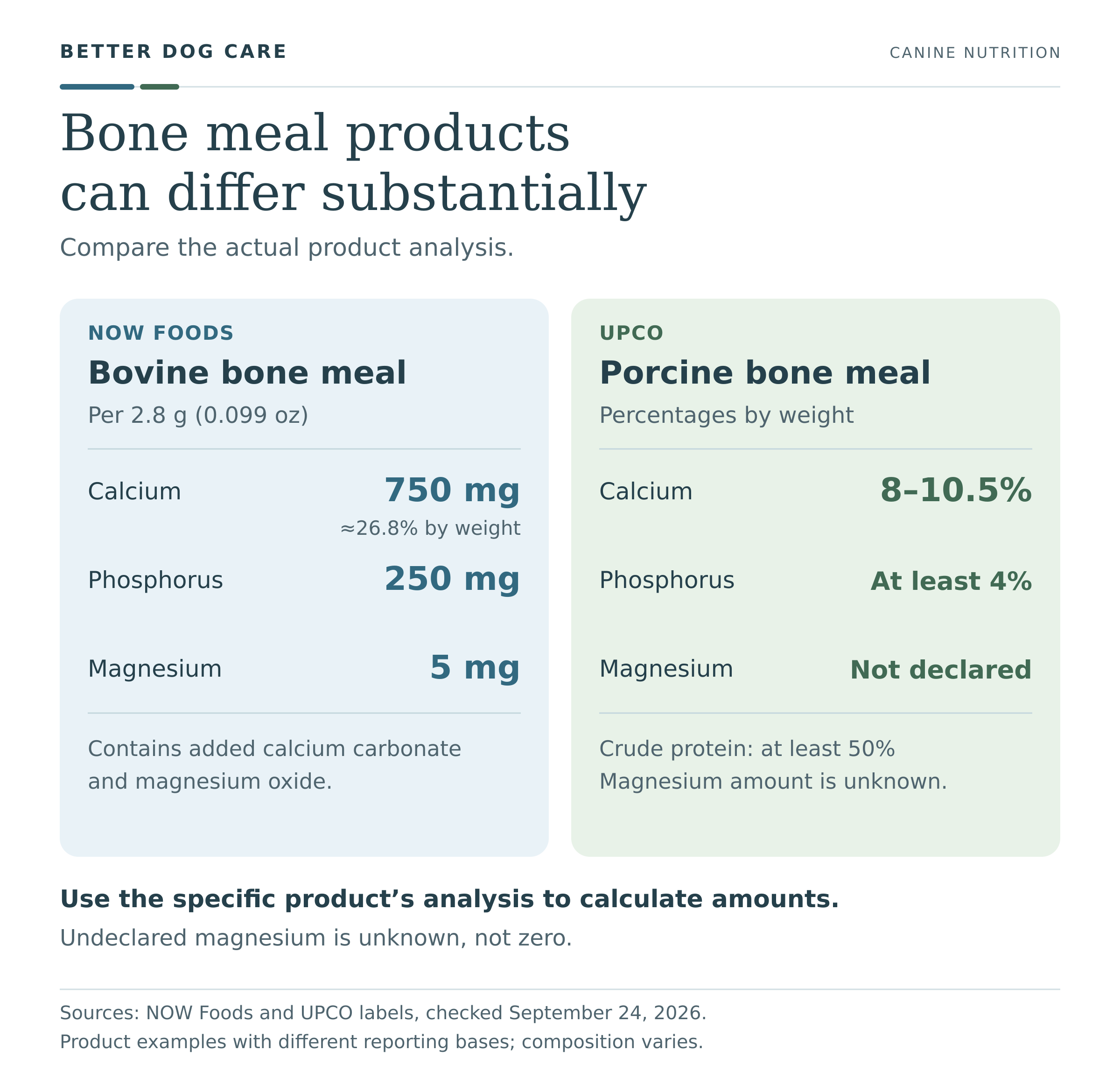
These are product differences, so beef bone meal is not necessarily richer in calcium than pork bone meal. The bovine product’s added carbonate is the same compound found in limestone and eggshell. Its added magnesium oxide contributes to the listed 5 mg of magnesium; an ingredient list alone cannot establish dietary adequacy. Unlisted magnesium is unknown, not necessarily absent. Ask the manufacturer for the missing value when needed.
Calculate the dose from the specific product’s analysis and recalculate calcium, phosphorus, and magnesium when switching products or animal sources. Typical or batch values are more useful than minimum/maximum guarantees alone.
Processing can also affect utilization. Poultry and pig studies show differences in phosphorus utilization among products and processing conditions, but cannot tell us which animal source dogs digest best.[11,12]
What about cottage cheese, goat milk, or yogurt?
Modest portions of the following dairy foods add relatively little calcium. A quarter cup provides approximately:
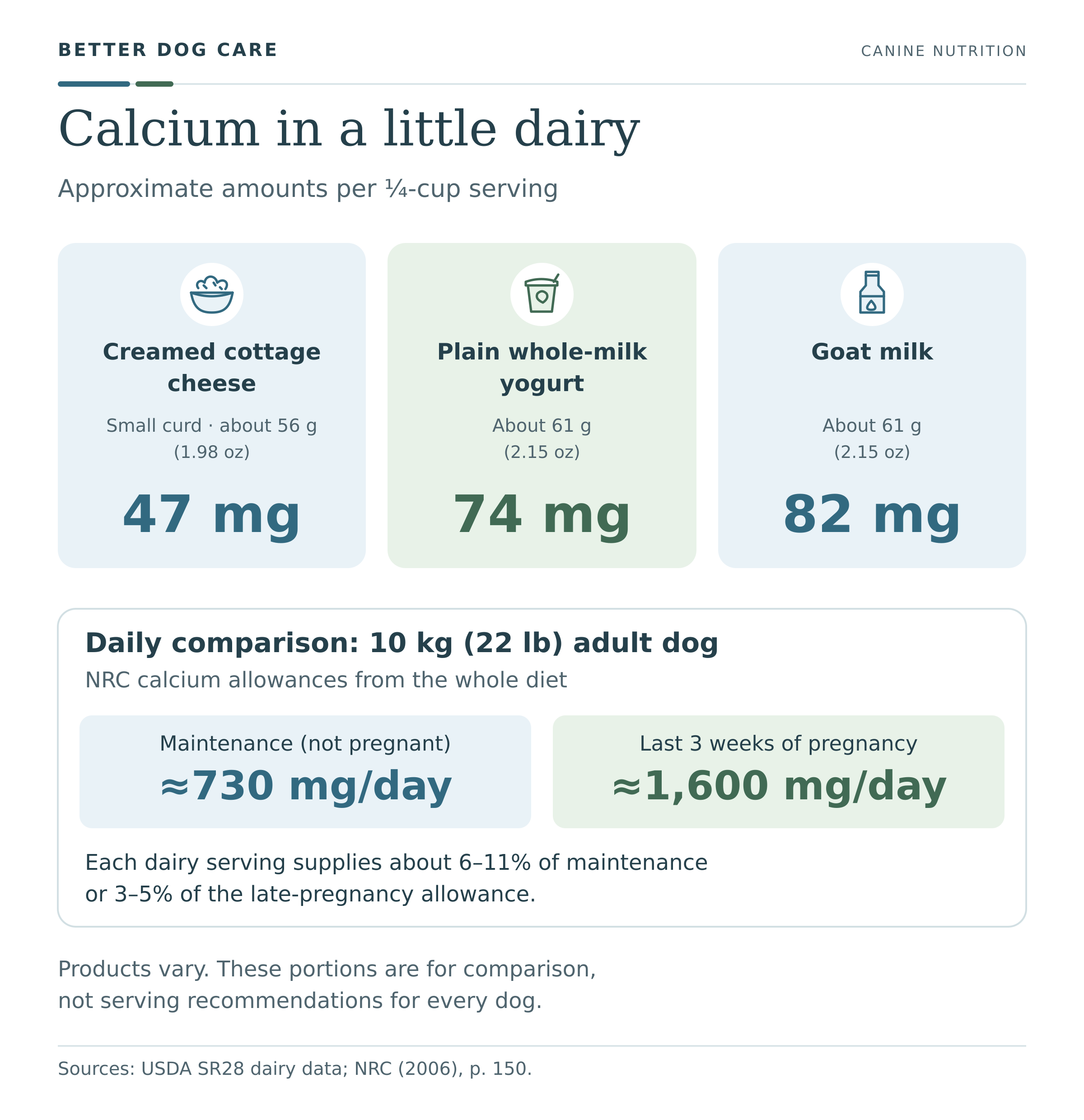
If a pregnant dog is reluctant to eat, a little dairy can make kibble or a homemade meal more appealing if she tolerates it. There is no reason to exclude it simply because it contains calcium. Keep portions appropriate for her size and intake; larger amounts add more calcium and calories and can displace balanced food, so include them in the diet calculation.
Nonfat cheeses, calcium-set tofu, calcium-fortified foods, and raw meaty bones can contribute substantial calcium. Count the calcium in the actual portion fed, especially when adding them regularly to an already balanced diet.[5,13,15]
Putting this into practice
Feed enough of a complete commercial diet suitable for reproduction, a homemade pregnancy recipe, or a combination balanced for her needs. Keep the calcium source and amount specified in the recipe, and recalculate when ingredients change.
In a nutshell:
“Don’t supplement” means avoiding unnecessary extra calcium. It should never mean removing the calcium that makes a diet adequate.
References
- National Research Council. 2006. Nutrient Requirements of Dogs and Cats. Washington, DC: The National Academies Press. Chapter 7, pp. 150, 153, 157–158; Table 15-8, pp. 362–363.
- Merck Veterinary Manual. Eclampsia in Small Animals.
- Merck Veterinary Manual. Physiology and Calcium-Regulating Hormones in Dogs and Cats.
- National Center for Biotechnology Information. PubChem. Calcium Carbonate, CID 10112.
- National Institutes of Health, Office of Dietary Supplements. Calcium: Fact Sheet for Health Professionals. Referenced for general calcium chemistry and absorption, not canine intake recommendations.
- University of Florida IFAS Extension. Concepts of Eggshell Quality.
- Merck Veterinary Manual. Nutritional Requirements of Small Animals.
- Merck Veterinary Manual. Subclinical Hypomagnesemia in Critically Ill Animals.
- NOW Foods. Bone Meal Powder: ingredient list and Supplement Facts. Label checked September 24, 2026; cited as a composition example, not a product recommendation.
- UPCO. Bone Meal Steamed Powder for Dogs & Cats: ingredients and guaranteed analysis. Label checked September 24, 2026; cited as a composition example, not an endorsement of the general feeding directions.
- Determination of pre-cecal phosphorus digestibility of inorganic phosphates and bone meal products in broilers. Poultry Science. 2017. Findings concern broilers, not canine absorption rates.
- Effects of particle size, ash content, and processing pressure on the bioavailability of phosphorus in meat and bone meal for swine. 2005. Findings concern meat and bone meal fed to pigs, not canine absorption rates.
- Dillitzer N, Becker N, Kienzle E. 2011. Intake of minerals, trace elements and vitamins in bone and raw food rations in adult dogs. British Journal of Nutrition. 106(S1):S53–S56. Cited for diet-calculation issues, not pregnancy requirements.
- USDA FoodData Central. Foundation Foods Documentation: Weights.
- USDA Agricultural Research Service. National Nutrient Database for Standard Reference, Release 28: Dairy and Egg Products. Entries 01012 (creamed cottage cheese), 01116 (plain whole-milk yogurt), and 01106 (goat milk, fluid, with added vitamin D). Calcium examples calculated for quarter-cup portions using 225 g (7.94 oz) per cup of small-curd cottage cheese, 245 g (8.64 oz) per cup of yogurt, and 244 g (8.61 oz) per cup of goat milk, with 83, 121, and 134 mg calcium per 100 g (3.53 oz), respectively. Yogurt cup weight is also documented in USDA’s Manual of Food Codes for Individual Intake, p. 005.
- U.S. Food and Drug Administration. “Complete and Balanced” Pet Food. Nutritional adequacy, life-stage nutrient profiles, and comparison of foods with different moisture contents.
- Association of American Feed Control Officials. Reading Labels. Nutritional adequacy statements, life stages, feeding directions, and products intended for intermittent or supplemental feeding.
- Merck Veterinary Manual. Feeding Practices in Small Animals. Feeding during gestation and the use of additional calcium, phosphorus, and vitamin D with complete diets for growth and reproduction.
- Merck Veterinary Manual. Dog and Cat Foods. Commercial food types, nutritional adequacy statements, and commercial raw diets.
- Association of American Feed Control Officials. Dog and Cat Food Nutrient Profiles: public revision tables and rationale. Dog food profiles based on calorie content, pp. 5–6; minimum calcium, phosphorus, and magnesium concentrations for Adult Maintenance and Growth and Reproduction.
- Minerals Technologies Inc. Annual report: mineral production and processing. Describes ground limestone and the manufacture of precipitated calcium carbonate from lime derived from mined limestone.
- Minerals Technologies Inc., Specialty Minerals. Food, Pharma, Consumer. Ground and precipitated calcium carbonate for food, pharmaceutical, and nutraceutical use; purity and heavy-metal controls.
- U.S. Food and Drug Administration. 21 CFR § 184.1191: Calcium carbonate. Manufacturing routes and Food Chemicals Codex specifications for the human-food ingredient; cited for ingredient quality, not canine nutrient requirements.
- Merck Veterinary Manual. Dystocia in Small Animals. Calcium’s role in uterine contractions and veterinary management of uterine inertia.
- Weir M, Williams K, Llera R, Ward E. VCA Animal Hospitals. Eclampsia in Dogs. Excessive calcium intake and suppression of parathyroid hormone production.
- Marigot Ltd. Aquamin FAQ, Aquamin F, and Marine Minerals for Health brochure. Trademark, algal source, product grades, and calcium/magnesium composition.
- Animal Essentials. Sea-Cal Powder: ingredients and guaranteed analysis. Label checked September 25, 2026. The current page identifies calcified Lithothamnion seaweed but does not name Aquamin as its supplier. Cited for composition, not general feeding directions.
- Zenk JL, Frestedt JL, Kuskowski MA. 2017. Effect of Calcium Derived from Lithothamnion sp. on Markers of Calcium Metabolism in Premenopausal Women. Journal of Medicinal Food. doi:10.1089/jmf.2017.0023. Pilot crossover trial in 12 women; cited for composition and PTH response, not canine absorption rates or gestation guidance.